Tuesday, August 30, 2022

Strasbourg, Saverne and more of Chateau du Lutzelbourg, Alsace France

We continue to enjoy "the good life" in France. 

We loved our walks around Strasbourg which is the 9th largest city in France.  It's much larger than many of the towns and villages we visit and there was much to see and admire.  Along the way we learned about the history, politics and culture of the area.

The beautiful St. Paul's Church which is a major Gothic Revival architecture building and one of the landmarks of Strasbourg, in Alsace, France.  It was built between 1892 and 1897.

The Bourse Quarter of Strasbourg

One artist had his work lining the Esplanade that enters Strasbourg.

Another sculpture by the same artist


The view as we are about to enter a lock on the Canal de la Marne au Rhin.  The tow paths along the canals are always popular with locals as well as visitors.    We continually see bicycle riders, runners, fishermen, joggers, walkers, families out for a stroll,  and campers.  All ages are seen enjoying the beauty created by these waterways.

Bouxwiller is a very old town located within the Saverne arrondissement 21 miles northwest of Strasbourg and has been occupied since Roman times.  The Jews have been living in Bouxwille since the early 1300s.  This synagogue was built in 1900 with the bulb marking the neo-Gothic orientalist style wanted at the time of its construction.  In 1950 it was restored and re-inaugurated after the occupation and devastation by the Germans during WWII.  

This is the watering system in Saverne for the beautiful planters along the main street/pedestrian walk.

One of the joys of barging is the community.  Gradually we are meeting and making friends.  This is a supportive group of people always happy to lend a helping hand and give advice.  Having this experience in common creates a bond that would normally take much more time to create.

We were able to catch up and have a drink with Rory and Caroline (owners and operators) of the luxury hotel barge Apres Tout between their charters. We always enjoy seeing them when our paths cross.  They have taken hotel barging to a whole new level.

We loved meeting Mark and Deb and spending time with them.  Their home port is Strasbourg and we look forward to seeing them again upon our return this fall.

One of our daily walks.

As many of you are aware, France as well as much of Europe has been faced with heat, little to no rain, and a resulting drought.  This was on top of an unusually mild winter.  Because of the lack of water in many areas of France our cruising grounds have been severely restricted.  For us this means we don't move as much or, conversely, we spend more time in the areas we visit.  We were in Lutzelbourg for over a week.  We loved being able to actually hike (as opposed to walking along the canal) almost every day.  We regularly visited the Chateau de Lutzelbourg.

Sweeping views from Chateau de Lutzelbourg


I couldn't decide which picture to delete, so I've instead included both pictures showing what the village of Lutzelbourg  looks like from above.

The views continue

We enjoyed exploring the Chateau ruins

More of the Chateau de Lutzelbourg


Friday, July 22, 2022

Hunawihr, Alsace, Grand-Est France. The Nature Park and the Garden of Butterflies

Dinner at a lovely restaurant in Strasbourg

With our dinner in Strasbourg we enjoyed this wine.  We liked it so much that we went to the winery, had a wonderful tasting with one of the family members, and of course filled our car with Rieslings from Blanck.


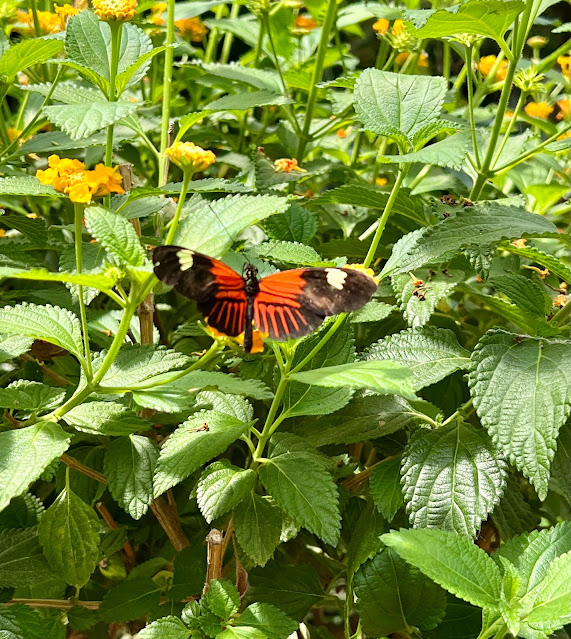
Using Strasbourg as  our home base we were able to explore many of the sights Alsace had to offer.  We visited  The Butterflies Garden.  In the tropical atmosphere of an acclimatized greenhouse building we witnessed an unimaginable array of colorful butterflies busily going about their daily business feasting on  all types of lush vegetation.  We had to be careful where we stepped.  The butterflies flew all around us, alighting on plants, flowers, or on the ground.  The butterflies were from brilliant blues, to red and black, to black and white and so much more.  Some were psychedelic as they flashed their colors flitting from flower to plant to feeding trays laid out for them.  Their life span is only about two weeks.  I didn't want to leave this incredible show of nature.  


We were careful where we stepped


We found a place for lunch.  I had my steak haché (aka raw hamburger meat) with an egg yoke to put on top. 


We ate on the patio with a lovely view of a vineyard.  After all, we are in Alsace.

The NaturOparC is the Reintroduction Center of Storks.  They are committed to the preservation of regional biodiversity and are involved in the breeding and reinforcement programs in the wild.  They have done it for the White Stork, the European Otter and the Great Hamster.There we saw storks in their natural environment.  We also viewed various other birds, animals, and fish.  

Two nests of baby storks

This stork was looking for food

There was a wonderful collection of turtles

Mealtime for the babies


There were storks everywhere you looked.  The park was lush, green and a beautiful place to spend part of a day.  Since it was near the butterfly park we saw escapees enjoying their freedom in this next door parkland.

Here is a little idea of what the nests look like in the beginning

Family time

Cormorant drying its wings.

There were other beautiful birds, besides the storks


The Great Hamsters


Saturday, July 16, 2022

Fort de Schoenenbourg, Chateau du Haut-Koenigsbourg, Hunspach Alsace France

The entrance to Fort de Schoenenbourg 

 Do you remember studying the Maginot Line in school? It was built between 1928 and 1940 by the French along their border with Germany and in the Alps with Italy.  Unfortunately France was defeated in June 1940.  Many said the Maginot Line had been a failure.  In reality it succeeded in its mission which was to protect the industrial zone of Alsace and Lorraine, allow the mobilization of the French army, and of the utmost importance avoid a surprise attack by the German Army in French territory.  Visiting one of the forts that made up the Maginot Line, which had been restored, was worth the time.  You need to allow a good 2 hours to cover the different galleries all of which are underground.  We saw how the soldiers lived underground.  Fort de Schoenenbourg was a civil engineering marvel.  This particular fort was the most heavily bombed construction of the Maginot Line.  On June 22, 1940 the armistice between France and Nazi Germany had been signed.  But the fort did not surrender.  The French high command had to tell them the war was over after which the fort was abandoned.


They used huge ammunition

Everything was built on a large scale.  The tools were built accordingly

The corridors are 1.85 miles (3 km) long and the fort is almost 100 feet deep (30 M)

Room for sleeping and taking breaks.

These are batteries which we assumed were for standby power in case their generators failed.


Another corridor with narrow gage railroad tracks for moving supplies and munitions.

Tom is showing off his shooting skills on this double barrel machine gun.

An example of the food supplies needed to feed 630 men

Samples of artwork the soldiers painted on the walls.


The land above the Fort

Hunspach is listed as One Of The Most Beautiful Villages of France.  The village has black and white half timbered houses that French refugees and Swiss immigrants built after theThirty Year War.  It is located near the Fort du Schoenenbourg.


Driving through Hunspach


We next visited Chateau du Haut-Koenigsbourg a medieval castle located in Alsace, France.  It was used by different powers from the Middle Ages until the thirty Years' War when it was abandoned.  From 1900 to 1908 it was rebuilt by the German kaiser Wilhelm II.  It is noted in history all the way back to 774.  The ruins have been listed as a historical monument since 1862 when the German kaiser Wilhelm II was granted the remains of the castle. His desire was to restore the castle, and reinforce the bond of Alsatians with Germany.  While his restoration is not completely accurate it shows Wilhelm II's romantic nationalist ideas of the past and the architect's work.  

Chateau du Haut-Koenigsbourg

Entrance

Roof top view

It's always about war and power.  There were big guns here.

Charming courtyard.  One side was for the servants (who were not to be seen), and the other side allowed for the important people to see and be seen.

German Kaiser Wilhelm II left his own mark in this room